Resource
The Real Estate Brokerage Marketing System
A practical operating map for building a brokerage that attracts qualified buyers and sellers, recruits productive agents, and stays visible across digital, physical, and event channels.
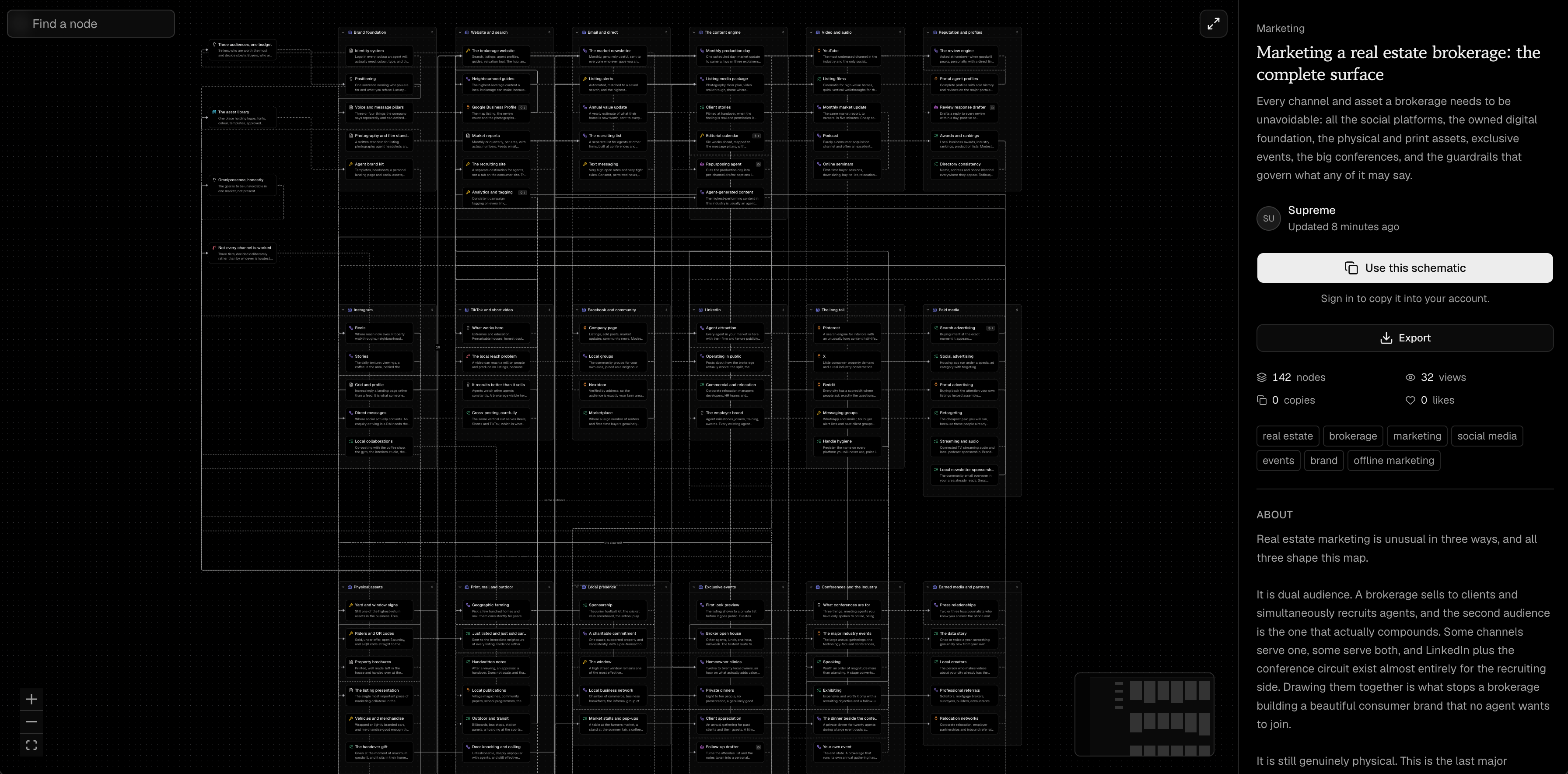
Treat marketing as one connected system
Most real estate businesses manage their website, portals, social channels, signs, events, CRM, and agent recruitment as separate activities. That creates inconsistent messages, fragmented data, slow follow-up, and no reliable view of what produces revenue.
The better model is a connected marketing system. Owned assets form the foundation, channels distribute the message, physical presence makes the brand visible locally, events create high-trust contact, and an operating layer connects people, data, measurement, and governance. The goal is not to be everywhere. It is to make every relevant touchpoint reinforce the same commercial position.
Design for buyers, sellers, and agents
A brokerage markets to at least three distinct audiences. Buyers need relevant inventory, context, and confidence. Sellers need proof that the brokerage can create demand and protect value. Productive agents need a platform that helps them win instructions, serve clients, and grow.
Define the ideal profile, urgent problem, promise, proof, next action, and qualification criteria for each audience. Give each one a clear path through the website and CRM. Combining all three into a generic message usually weakens conversion and makes useful measurement impossible.
Build the owned foundation first
Every campaign should lead toward assets and data the brokerage controls. Start with a fast website, dedicated buyer, seller, development, location, and agent-recruitment pages, a properly configured CRM, consented first-party data, analytics, a reusable content library, email journeys, and clear proof such as market insight, testimonials, and case studies.
Make local discovery explicit. Maintain accurate business profiles, build useful area and property-type pages, answer the questions prospects actually ask, and structure content so search engines and AI assistants can understand the brokerage, its markets, services, people, and evidence.
Use channels as distribution, not strategy
Select channels from audience intent rather than fashion. Search, local SEO, AEO, and property portals capture active demand. Instagram and video can build familiarity and demonstrate market access. LinkedIn is often more useful for partnerships, credibility, and agent recruitment. Paid media can accelerate proven messages, but it should not compensate for an unclear offer or weak follow-up.
For each channel, define its audience, job, content format, destination, call to action, owner, publishing rhythm, and success metric. Repurpose one strong market insight across formats instead of asking the team to invent disconnected content every day.
Make physical presence and events measurable
Real estate remains unusually physical. Boards, windows, brochures, direct mail, local sponsorships, open houses, launch events, private dinners, and conferences can all create serious commercial value. Treat them as first-class parts of the system rather than unmeasured brand activity.
Use distinct landing pages, QR codes, phone numbers, invitation lists, campaign identifiers, and CRM source fields. Separate client events from agent-recruitment events because the audiences, follow-up, and success criteria are different. Measure qualified conversations, appointments, instructions, candidate quality, and influenced pipeline.
Connect qualification and follow-up
Speed matters, but indiscriminate automation creates a poor experience. Capture the reason for moving, location, property type, timing, budget or expected value, financing status, and preferred contact method. Use that information to score, route, and personalize follow-up.
AI can summarize inquiries, enrich records, identify intent, recommend next actions, and draft useful follow-up. People should remain responsible for advice, negotiation, sensitive conversations, relationship building, and final decisions. Set response-time targets and give every qualified lead a named owner.
A practical 90-day rollout
Days 1 to 15: inventory every channel, asset, tool, vendor, audience, conversion path, data source, and recurring cost. Establish baseline metrics and identify where leads are lost.
Days 16 to 30: define positioning, buyer, seller, and agent profiles, core offers, proof, qualification rules, and the measurement plan. Choose the few channels that deserve focus first.
Days 31 to 60: repair the owned foundation. Improve priority pages, CRM stages, attribution, consent, lead routing, follow-up sequences, reporting, and the shared content system.
Days 61 to 90: launch one coordinated campaign across owned, distributed, and physical touchpoints. Add one high-trust event or partnership experiment. Review results weekly, document what works, and remove activity that does not create qualified demand.
Measure commercial outcomes
Track qualified buyer and seller inquiries, instruction or listing appointments, appointment-to-client rate, response time, source-to-close conversion, acquisition cost, pipeline velocity, agent candidate quality, owned-audience growth, and content-assisted conversions. Channel metrics such as reach, clicks, or scans are diagnostic signals, not the final outcome.
Use one shared definition of a qualified lead and one source-of-truth dashboard. Review leading indicators weekly, pipeline monthly, and positioning, channel mix, and operating assumptions quarterly.
Put guardrails inside the workflow
Requirements vary by country and market. Build review steps for housing and equal-opportunity rules, licensing disclosures, advertising standards, privacy and consent, testimonials, creator partnerships, image rights, portal or MLS data terms, and AI-assisted claims.
Assign an owner, approval status, source, expiry date, and audit trail to reusable claims and assets. Compliance should be part of briefing, creation, publishing, and measurement, not a final check after the work is complete.
Explore the full marketing map
The original 142-node schematic maps the complete surface across owned channels, social distribution, physical assets, events, people, tooling, and guardrails. Use it as an audit canvas with your leadership, marketing, sales, and operations teams.
Credit: Supreme, “Marketing a real estate brokerage: the complete surface,” published on Schematic under CC BY 4.0.
Frequently asked questions
What should a real estate brokerage marketing system include?
It should connect positioning, a conversion-focused website, local search, property portals, content, social distribution, paid acquisition, email, CRM, offline visibility, events, lead qualification, agent recruitment, measurement, and compliance.
Which marketing channels work best for real estate brokerages?
The best mix depends on the market and audience. Search and property portals capture existing intent, while social content, local partnerships, direct mail, signage, private events, and referral programs create demand and trust.
How can a brokerage use AI without losing the human touch?
Use AI for research, classification, summaries, personalization, content adaptation, and workflow support. Keep people responsible for advice, negotiation, sensitive communication, relationship building, and final approval.
How should offline real estate marketing be measured?
Give signs, print, sponsorships, open houses, and events unique URLs, QR codes, phone numbers, campaign identifiers, and CRM source fields. Measure qualified conversations and appointments rather than scans alone.
Should a brokerage outsource its marketing or build it in-house?
A hybrid model is often strongest. External specialists can design and accelerate the system, while the brokerage owns the data, customer knowledge, core workflows, and capabilities it needs to operate every day.